
Trust
Explores the tendency to place confidence in other people and approach interactions with appropriate openness.
Customer Service Profile™ assessment
Measure service-related behavioral traits, two basic proficiencies, and alignment with the way your organization expects customer service to be delivered.
Customer service job fit
Customer Service Profile™ compares an individual's service-related traits and proficiencies with a Performance Model and your company's service perspective.
The system can support general customer-service roles or more specialized environments such as hospitality, healthcare, financial services, and retail. Reports help managers screen, interview, select, onboard, and coach with a consistent service standard.
The assessment supports the decision. It does not replace a structured interview, work sample, experience evidence, references, or direct observation of customer-service skill.
What Customer Service Profile™ measures
Explores the tendency to place confidence in other people and approach interactions with appropriate openness.
Explores how directly or diplomatically a person may communicate in customer situations.
Explores the tendency to recognize and respond to another person's feelings and perspective.
Explores comfort with rules, procedures, standards, and consistent service practices.
Explores concentration, attention, and the ability to stay engaged with a task or customer need.
Explores adaptability when customer needs, priorities, or service situations change.
Measures a basic verbal proficiency relevant to understanding and communicating information.
Measures a basic numerical proficiency relevant to common customer-service tasks.
See the assessment
Watch the overview, then review the official brochure and actual Customer Service Profile sample report library.
A company-specific service model
Clarify the customer interactions, service expectations, proficiencies, and behaviors the role requires.
Create the benchmark for the role and define the organization's company service perspective.
Invite the candidate to complete the online assessment without requiring proctoring.
Compare the person's traits, proficiencies, and service perspective with the role's Performance Model.
Use report guidance to verify gaps, make the broader decision, and personalize onboarding or coaching.
Use the assessment responsibly
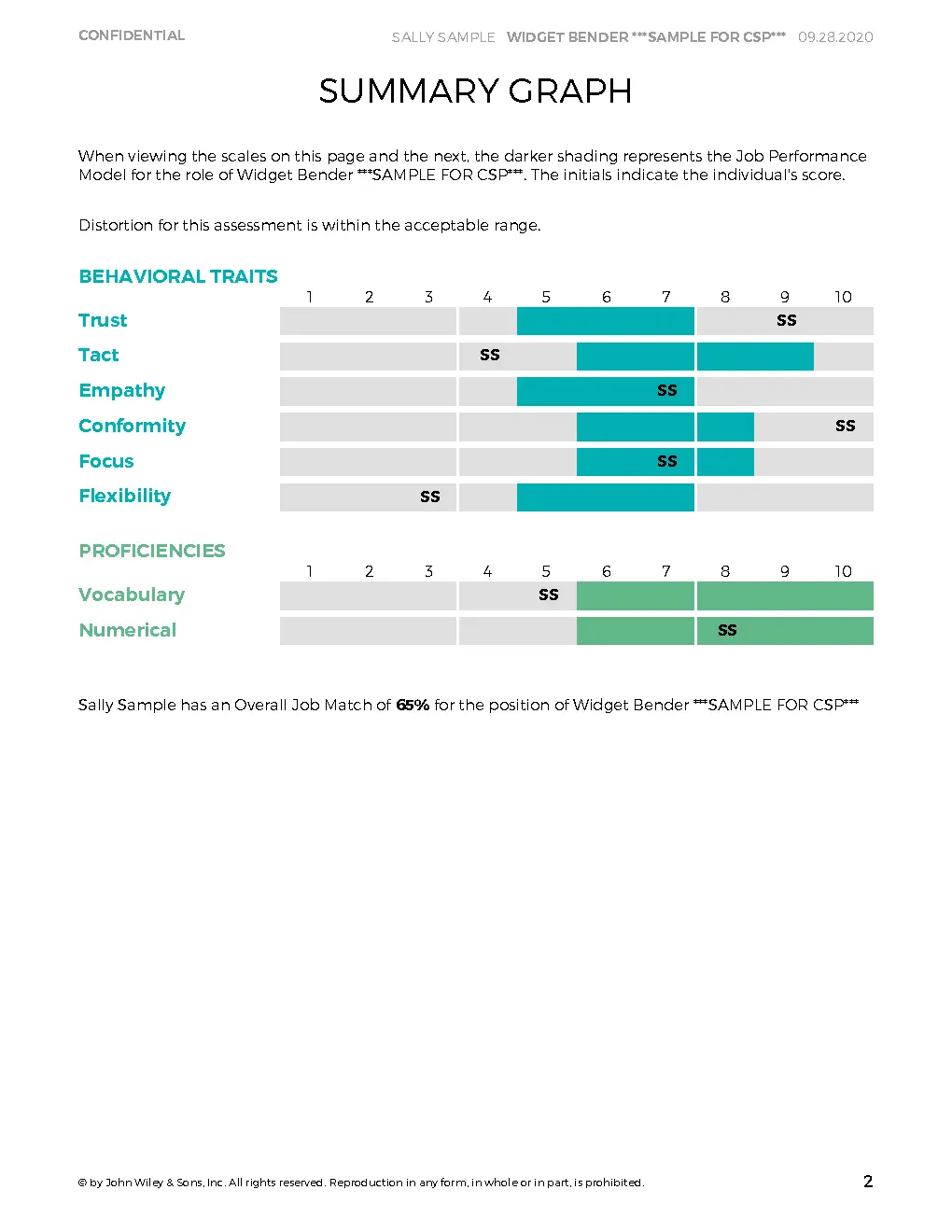
More than a service score
Customer Service Profile reporting compares the individual with the Performance Model and company service perspective, then provides practical support for selection and development.
Compares the candidate with the Performance Model and provides considerations for interviewing.
Summarizes the individual's assessment results and service-related characteristics.
Compares a candidate with the defined customer-service role requirements.
Shows how one individual compares with multiple available service roles.
Provides management considerations for developing customer-service behavior and alignment.
Examines alignment between the individual's service perspective and the company's defined standard.
Documents the benchmark used to define the role's customer-service requirements.
Compares service perspectives across individuals or groups.
Supports review of a Performance Model built from people currently performing the role.
Customer Service Profile™ questions
Customer Service Profile™ is an assessment that measures customer-service-related traits, two basic proficiencies, and alignment with a company service perspective and role-specific Performance Model.
It measures Trust, Tact, Empathy, Conformity, Focus, and Flexibility.
It measures basic Vocabulary and Numeric proficiency relevant to customer-service work.
It is the organization's defined standard for how customer service should be delivered. Individual results can be compared with that perspective to examine alignment.
Yes. Organizations can create Performance Models for different departments, roles, and service environments.
The current publisher guidance is approximately 30 to 40 minutes, depending on the individual and configuration.
No. It adds assessment evidence to the decision. It cannot guarantee performance and should be used with interviews, work samples, references, experience, and other job-related information.
Reports support selection, candidate matching, multi-job matching, customer-service alignment, coaching, company service perspective comparison, and Performance Model review.
Start with a real workforce decision
Tell us what you’re trying to improve. We’ll help determine whether there’s a fit.