
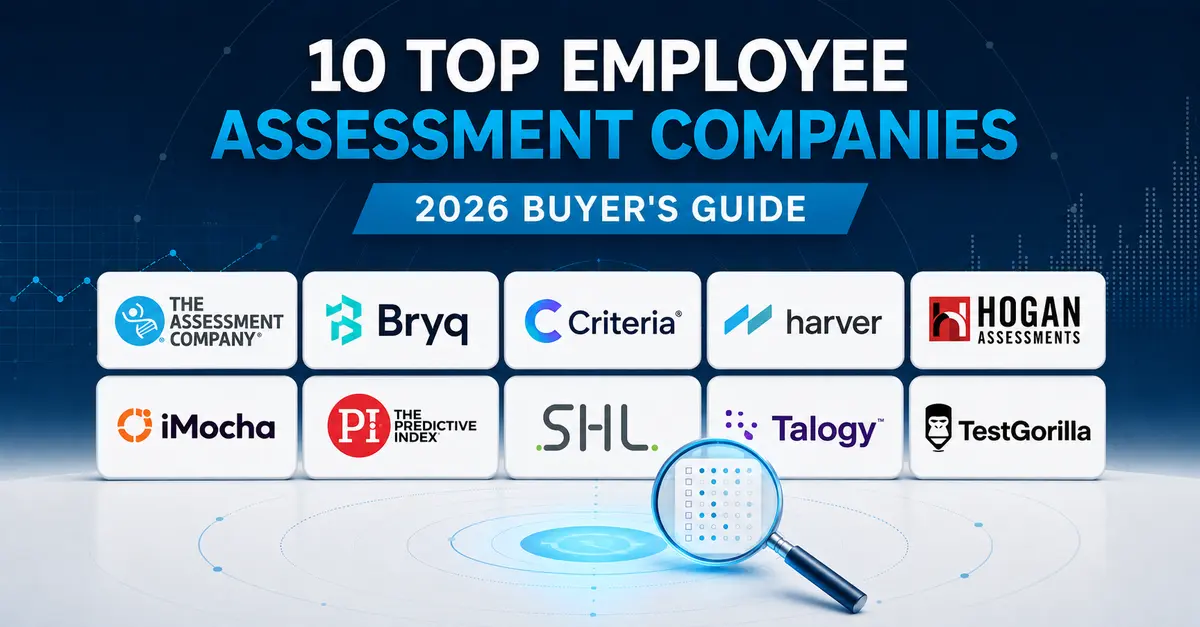
The employee assessment market includes global enterprise suites, self-service skills platforms, high-volume hiring systems, leadership specialists, and implementation-led providers. Treating them as interchangeable creates a weak comparison. The right question is not “Who has the most tests?” It is “Which provider fits the decision we need to improve?”
After more than 30 years in this business, I have learned that a long feature list can hide the question that matters most. Who will help your managers define the job, understand the evidence, and use it after the contract is signed? Buyers should compare the service model as carefully as they compare the assessments.
Top employee assessment companies at a glance
The companies are not presented as a universal numerical ranking. They appear in alphabetical order, ignoring “The,” and are compared by the workforce decision each is particularly well positioned to support.
Select a company name to read its overview below.
| Company | Strong fit for | Primary emphasis | Buying model |
|---|---|---|---|
| The Assessment Company® | Hands-on job-fit implementation and manager support | PXT Select, position-specific Performance Models, structured interviews, and supporting assessments | Unit-based, unlimited-use, and enterprise options |
| Bryq | Mid-market teams wanting one combined candidate profile | Cognitive ability, behavioral traits, hard skills, and AI fluency | Published subscription plans |
| Criteria Corp | Small and mid-market employers wanting broad psychometric coverage | Aptitude, personality, emotional intelligence, risk, skills, and interviewing | Subscription and custom quote |
| Harver | Enterprise, frontline, and high-volume hiring | Predictive assessments, realistic job previews, automation, and scheduling | Enterprise quote |
| Hogan Assessments | Leadership selection, development, and personality risk | Everyday strengths, derailers under pressure, motives, values, and culture | Direct and authorized partner delivery |
| iMocha | Technical skills validation and enterprise skills intelligence | Skills architecture, skills inference, assessments, and internal mobility | Custom enterprise pricing |
| The Predictive Index | Behavioral insight, team alignment, and manager adoption | Behavioral and cognitive assessments across the employee lifecycle | Subscription and provider-supported delivery |
| SHL | Global enterprises with complex roles and hiring systems | Personality, cognitive ability, skills, knowledge, and job simulations | Enterprise programs and self-service options |
| Talogy | Custom enterprise assessment and development programs | Modular assessments, consulting, assessment centers, and leadership solutions | Consultative and custom programs |
| TestGorilla | Self-service skills screening across many job families | Skills, cognitive ability, language, software, coding, and custom questions | Self-service plans and enterprise options |
How these employee assessment companies were selected and compared
We began with companies appearing in independent software-review and HR vendor directories, including G2, Shortlister, and the SHRM Vendor Directory. We then verified current capabilities against each company's official product, science, integration, and pricing information available as of July 23, 2026.
Inclusion required an active employee-assessment offering, evidence of meaningful market use, and a distinct reason an employer might select the company. This is not a market-share study, a customer satisfaction award, or a paid placement list. We did not assign numerical scores because the providers serve materially different use cases and buying environments.
- Job relevance and intended useDoes the assessment connect clearly with the work and the employment decision?
- Science and validationDoes the provider explain what is measured and offer appropriate evidence of validity and reliability?
- Assessment depth and coverageDoes the company cover the required cognitive, behavioral, personality, skill, integrity, leadership, or simulation needs?
- Scale, workflow, and integrationsCan the solution support the employer's applicant volume, locations, ATS, HRIS, security, and reporting requirements?
- Implementation and manager supportWill the provider help define the job, configure the process, train users, and turn reports into action?
- Candidate experience and accessibilityIs the process understandable, appropriately timed, accessible, and consistent for candidates?
- Actionability and measurable outcomesCan employers use the information in interviews, onboarding, coaching, development, and outcome analysis?
Assessment publisher, software platform, or implementation provider?
Many comparison lists combine three different business models. That can distort the results because a large software platform and a hands-on implementation provider solve different parts of the assessment process.
Builds the assessment science
Creates, validates, and maintains assessment instruments, scoring, norms, and technical documentation.
Runs the digital workflow
Manages test libraries, candidate invitations, automation, reporting, security, and HR technology integrations.
Turns tools into workforce decisions
Helps define the job, select appropriate measures, configure standards, train managers, interpret results, and measure outcomes.
Some companies perform more than one role. Software rankings naturally favor publishers and SaaS platforms because they compare product features, integrations, and review volume. A provider comparison should also evaluate job analysis, implementation expertise, manager adoption, and post-purchase support.
The Assessment Company® is a national employee assessment firm founded in 1993. As an Authorized Wiley Partner, the company provides PXT Select and combines it with Occupational DNA®, position-specific Performance Models, structured interview support, and hands-on implementation for employers across the United States.
The Assessment Company®
The Assessment Company® is an assessment provider and implementation partner founded in 1993 and an Authorized Wiley Partner. Its lead hiring solution, PXT Select, measures thinking style, behavioral traits, and occupational interests. Candidate results can be compared with a position-specific Performance Model and used to generate structured interview questions.
The company's Occupational DNA® process adds job analysis and, when appropriate, top-performer evidence. Supporting solutions address leadership feedback, communication, integrity, safety attitudes, and customer-service job fit. The distinction is service: clients work with an experienced assessment practitioner rather than simply receiving access to a test library.
Consideration: The Assessment Company® does not provide technical skills testing. It is not a high-volume applicant workflow platform or a global ATS integration suite. Employers needing deep automation, coding simulations, or large technical-test libraries should compare providers such as Harver, iMocha, SHL, or TestGorilla.
Bryq
Strong fit: Mid-market employers that want cognitive, behavioral, and hard-skill evidence combined in one candidate profile.
Bryq combines cognitive ability, behavioral traits, hard skills, and AI fluency. It emphasizes quality of hire, candidate matching, ATS connectivity, and published subscription pricing. Its unified profile can reduce the need to assemble several separate screening tools.
Consideration: Buyers should verify the depth of role-specific content needed for their positions and compare the subscription with expected candidate volume. A unified platform is useful only when its measures match the actual work.
Criteria Corp
Strong fit: Small and mid-market organizations seeking a broad, science-focused pre-employment assessment platform.
Criteria Corp offers cognitive aptitude, personality, emotional intelligence, risk, skills, game-based assessments, proctoring, and interviewing tools. The company reports more than 80 million completed assessments and serves more than 4,000 organizations. It also offers integrations with ATS and HR platforms.
Consideration: Employers should compare the complete subscription and module mix with actual hiring volume. Organizations wanting intensive job modeling or ongoing consulting should clarify how much implementation support is included.
Harver
Strong fit: Large employers hiring high volumes of frontline, contact-center, retail, hospitality, or operational talent.
Harver combines predictive assessments with screening, realistic job previews, candidate matching, automated progression, and interview scheduling. That workflow focus is valuable when thousands of candidates must move through a consistent process across locations.
Consideration: Harver's scale and automation may be more than a lower-volume employer needs. Buyers should determine whether their primary problem is applicant throughput, job fit, or assessment depth before committing to an enterprise workflow.
Hogan Assessments
Strong fit: Leadership selection, succession, executive development, and understanding personality-related risk.
Hogan Assessments is known for measuring the everyday side of personality, potential derailers under pressure, and the motives and values that shape culture. Its Leadership Forecast Series is designed for selection, development, and succession decisions.
Consideration: Hogan is a personality and leadership specialist. Employers hiring for technical or operational capability may need to add cognitive tests, work samples, knowledge tests, or other job-specific evidence.
iMocha
Strong fit: Enterprises that need technical skills validation, workforce skill visibility, and integration with major talent systems.
iMocha emphasizes skills intelligence rather than a one-time hiring test. Its platform supports skills architecture, skills inference, thousands of assessments and real-world evaluations, skill-gap analysis, upskilling, internal mobility, and integrations with platforms such as Workday and SAP SuccessFactors.
Consideration: iMocha is strongest when learned skills and workforce capability are the central questions. Employers seeking whole-person job fit, personality risk, or hands-on manager interpretation may need another assessment layer.
The Predictive Index
Strong fit: Organizations that want a fast behavioral language managers can use for hiring, teams, relationships, and performance.
The Predictive Index uses behavioral and cognitive data across hiring and the employee lifecycle. Its broader talent-optimization approach connects candidate selection with team design, manager development, relationships, and ongoing performance.
Consideration: PI does not offer the same hard-skill library as skills-first platforms. Its value also depends on manager adoption. A short behavioral assessment can become unused data if leaders are not trained to apply the information.
SHL
Strong fit: Global enterprises with complex roles, large applicant populations, multilingual needs, and established HR technology.
SHL provides one of the broadest assessment portfolios in the market, including cognitive ability, personality, skills, knowledge, situational judgment, and job simulations. Its enterprise scale and established occupational-assessment history make it a logical candidate for multinational programs.
Consideration: Breadth and enterprise configuration can add cost and complexity. Smaller employers should compare SHL Online or a narrower provider with the implementation effort required for a larger enterprise program.
Talogy
Strong fit: Enterprises that need a customized combination of assessments, consulting, assessment centers, and development support.
Talogy combines modular assessment technology with consulting services. Its portfolio spans early careers, industrial hiring, leadership, competency and behavior, cognitive ability, emotional intelligence, assessment centers, coaching, and development.
Consideration: Custom design and consulting can require a longer buying and implementation process than self-service software. Employers should define the desired level of customization before comparing cost.
TestGorilla
Strong fit: Employers that want a self-service test library for skills-based screening across many job families.
TestGorilla offers more than 350 tests covering cognitive ability, languages, personality and culture, programming, role-specific skills, situational judgment, software, and typing. Employers can combine tests with custom questions, video responses, resume scoring, and AI interviews.
Consideration: A large self-service library shifts more responsibility to the buyer. Employers still need to define the job, select relevant measures, set appropriate cut scores, and review adverse impact. G2 reviews also show that some customers raise concerns about pricing and subscription limits.
Compare employee assessment companies by employer need
The Assessment Company®
For PXT Select job-fit modeling, structured interviews, and manager support.
Read provider overview →Bryq
For cognitive, behavioral, hard-skill, and AI-fluency signals in one profile.
Read provider overview →Criteria Corp
For broad pre-employment assessments and interviewing tools.
Read provider overview →Harver
For large frontline applicant populations and automated hiring workflows.
Read provider overview →Hogan Assessments
For leadership potential, derailers, motives, values, and succession.
Read provider overview →iMocha
For skills validation, skills architecture, and enterprise workforce intelligence.
Read provider overview →The Predictive Index
For a practical behavioral language used across hiring and management.
Read provider overview →SHL
For multinational programs, complex roles, and broad assessment coverage.
Read provider overview →Talogy
For tailored programs that combine assessments, consulting, and development.
Read provider overview →TestGorilla
For quick access to a broad test library across many job families.
Read provider overview →How to choose a pre-employment assessment company
Use these seven questions to separate a relevant assessment program from a long feature list.
- What business outcome must improve?Define turnover, quality, time to proficiency, safety, sales performance, leadership effectiveness, or another measurable result.
- What does the job require?Complete an appropriate job analysis before selecting assessments or setting decision rules.
- What does each assessment measure?Separate learned skills, cognitive ability, behavioral traits, personality, interests, integrity-related attitudes, and simulations.
- What validation evidence applies to our intended use?Ask for technical documentation and evidence relevant to the roles and decisions involved.
- What support is included?Clarify job modeling, implementation, manager training, interpretation, technical help, and ongoing review.
- What is the complete annual cost?Include licenses, candidate credits, integrations, implementation, training, consulting, minimums, and renewal terms.
- How will we measure results?Agree on baseline metrics, pilot roles, review dates, and the evidence required before expanding.
Use a pilot to test value before expanding
A provider comparison is only the beginning. Select one or two important roles, establish baseline outcomes, train the decision-makers, and run a controlled pilot. Review candidate completion, hiring-manager use, 90-day turnover, time to proficiency, performance, and other outcomes tied to the job.
For example, assume an employer experiences 20 avoidable early departures per year at an estimated cost of $7,500 each. That is $150,000 in annual turnover exposure. Preventing five of those departures would produce $37,500 in estimated savings before counting productivity, overtime, customer impact, or manager time. The numbers are illustrative. The employer should replace them with its own documented costs and results.
Choose the assessment company that fits the decision
Do not select an assessment company because it appears first in a search result or has the longest feature list. Build a shortlist based on the decision, the roles, the evidence required, the implementation model, and the outcomes the organization will measure.
Most employers should compare two or three providers with clearly different strengths. Ask each company to explain what it measures, what it does not measure, how the process connects with the job, and what support will be provided after the contract is signed. The strongest choice is the one that fits the work and produces evidence managers will actually use.
If hands-on job-fit implementation is the need, review The Assessment Company's employee assessment solutions. If the decision is still unclear, discuss the role and hiring process with The Assessment Company® before selecting a tool.