
Most organizations do not have a shortage of safety rules. The harder problem is what happens when a supervisor must apply those rules while production is behind, the crew is frustrated, conditions are changing, and a decision cannot be delayed.
That is where safety leadership becomes observable. Does the supervisor pause and evaluate? Correct a shortcut? Invite a worker to speak up? Follow through after delegating? Explain why a procedure changed? Stop work when the risk is unacceptable?
The Assessment Company® helps employers examine that behavioral layer with Safety Quotient™, Safety Quotient for Leaders, and Safety Self-Awareness training. The goal is not to blame the person for a weak system. The goal is to give leaders better insight into how their natural tendencies may influence decisions inside the system they are responsible for executing.
Why this matters now
OSHA updated its National Emphasis Program for indoor and outdoor heat hazards on April 10, 2026. The program directs inspections and outreach toward 55 high-risk industries and remains effective for five years. Heat is one timely example of a broader leadership problem.
A company may have a heat plan, hydration supplies, rest schedules, training, and emergency procedures. A supervisor still has to recognize changing conditions, apply the plan under production pressure, listen when someone reports symptoms, and act before the situation becomes an emergency.
The same issue appears in lockout decisions, vehicle use, lifting, confined spaces, protective equipment, housekeeping, maintenance, and every other area where the written standard meets real work.
Six behavioral dimensions that can affect safety leadership
Safety Quotient for Leaders organizes self-awareness across six dimensions. The assessment does not label one end of every dimension as good and the other as bad. A result must be interpreted in context. The work, exposure, pressure, team, combination of traits, and leader’s actual behavior all matter.
| Dimension | Leadership issue | Question to examine |
|---|---|---|
| RESISTANT — ACCOMMODATING | Response to rules, retraining, feedback, and new ideas | Will the supervisor explain and reinforce a changed procedure, or resist it before the crew? |
| ANXIOUS — CALM | Stress response and clear thinking under pressure | When conditions change quickly, can the supervisor slow down, gather facts, and make the next safe decision? |
| IMPATIENT — PATIENT | Emotional control and response to frustration | Will the supervisor correct unsafe behavior promptly without allowing frustration to damage communication? |
| DISTRACTIBLE — FOCUSED | Attention, completion, and follow-through | Does the supervisor verify that delegated safety actions were completed when priorities shift? |
| IMPULSIVE — CAUTIOUS | Decision speed and consideration of consequences | Does the supervisor pause long enough to consider who could be affected before acting? |
| THRILL-SEEKING — APPREHENSIVE | Comfort with uncertainty, novelty, and risk | Can the supervisor distinguish a reasonable operational risk from one that should not be tolerated? |
What the actual Safety Quotient for Leaders report provides
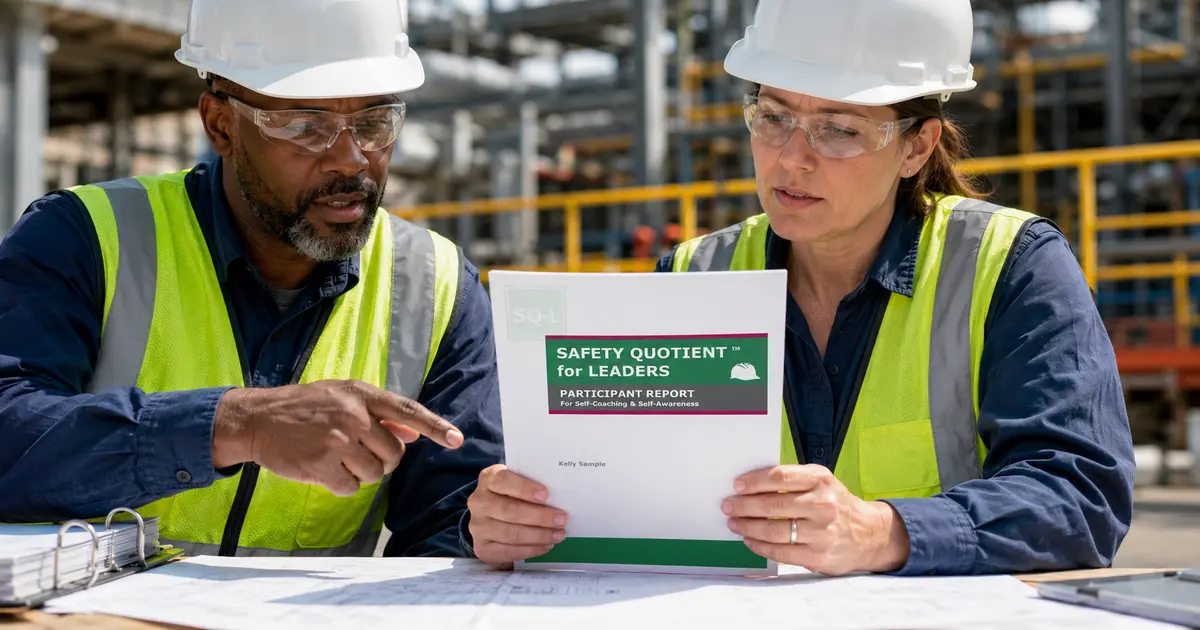
The participant report is designed for self-coaching and self-awareness. It is not a generic personality profile with the word “safety” added to it. The report connects six safety-related behavioral dimensions with leadership situations and action planning.
Safety Personality Profile
Shows the leader’s position across all six dimensions and identifies primary traits for closer review.
Self-Coaching Considerations
Provides positive aspects, possible risk areas, individualized coaching suggestions, and reflection prompts for each dimension.
SafeSELF Action Plan
Helps the leader examine specific behaviors, triggers, potential consequences, improvement goals, obstacles, and actions.
A coaching conversation
Gives the leader and manager a structured starting point for discussing observable behavior instead of relying on general advice.
A real operating example: production pressure and heat
Consider a supervisor leading an outdoor crew. Conditions are hotter than expected, one employee is newly assigned, and the project is behind schedule. The company has a heat plan. Water and shade are available. The issue is whether the plan will be applied consistently.
- A more resistant leader may question the change.
The coaching issue is not blind compliance. It is whether the leader understands the reason for the control and reinforces it consistently while using the proper channel to raise legitimate concerns.
- An impatient leader may feel pressure to keep the crew moving.
The action plan may include defined pause points, a visible break schedule, and a commitment to correct unsafe pressure before it becomes the crew’s unwritten standard.
- A distractible leader may miss follow-through.
Delegating water checks or monitoring does not complete the task. The leader needs a verification routine that survives changing priorities and interruptions.
- An impulsive leader may act before considering consequences.
A short decision routine can require the supervisor to consider the exposure, affected people, available controls, and worst credible outcome before proceeding.
Those examples are coaching hypotheses, not diagnoses. A result does not prove how a supervisor behaved or caused an incident. The debrief must connect the report with observed behavior, documented work demands, and the organization’s safety expectations.
How to turn the report into a working leadership process
- Define the supervisor decisions that matter.
Identify where leaders must correct, escalate, slow, stop, verify, communicate, or coach. Keep the discussion tied to the actual work.
- Complete the assessment and debrief the full report.
Do not reduce the result to one score or three primary traits. Review all six dimensions, strengths, possible risk areas, and the context in which they may appear.
- Select one or two observable behaviors.
“Improve safety leadership” is too vague. “Verify delegated safety actions before shift end” can be observed, coached, and measured.
- Complete the SafeSELF Action Plan.
Use a real example. Identify the trigger, possible consequences, improvement goal, barriers, and specific actions the leader will take in the next similar situation.
- Schedule follow-up before the debrief ends.
Review the behavior after 30, 60, and 90 days. Ask for examples, observations, obstacles, and evidence of follow-through.
- Measure the operating result carefully.
Track leading indicators such as corrective-action follow-through, hazard reporting, coaching completion, stop-work use, and verified field observations. Review incidents and near misses without claiming the assessment caused every change.
What the business case should measure
The return does not come from administering an assessment. It comes from changing behavior that affects exposure, communication, follow-through, and decision quality.
Use a transparent break-even calculation. Divide the complete program cost by the organization’s documented fully loaded cost of a safety incident or operational disruption. For illustration, a $15,000 program cost divided by a $30,000 incident-equivalent cost equals 0.5. That means the financial break-even point is one-half of that incident-equivalent exposure.
That example is not TAC pricing, an industry benchmark, or a promised result. It does not prove the program will prevent an incident. Employers should use their actual program cost, medical and claim costs, labor, equipment downtime, investigation time, replacement staffing, schedule impact, and other documented exposure.
Keep the assessment in its proper role
| Safety Quotient for Leaders can support | It cannot replace or establish |
|---|---|
| Self-awareness across six safety-related dimensions | A prediction that a specific incident will or will not occur |
| Individualized self-coaching considerations | A medical, anxiety, attention, or personality diagnosis |
| A structured SafeSELF Action Plan | Proof that a leader caused an incident |
| More focused manager coaching and follow-up | Hazard controls, training, staffing, procedures, or supervision |
| A consistent language for discussing behavioral risk | A complete employment or safety decision |
If Safety Quotient is used before hiring, the employer should document job relevance, follow the publisher’s technical guidance, administer the process consistently, provide appropriate accommodations, review adverse impact, protect candidate data, and combine the result with other job-related evidence. The assessment supports human judgment. It does not replace it.
The decision
Employers should not ask a written safety plan to overcome unexamined supervisor behavior. Define the critical decisions. Give leaders useful behavioral insight. Turn that insight into one or two observable actions. Then coach and measure the follow-through.
The Assessment Company® can help you determine whether Safety Quotient, Safety Quotient for Leaders, and Safety Self-Awareness training fit your hiring, onboarding, leadership, and safety-development process.